Outbound strategy
Cold Email vs LinkedIn Ads for Enterprise B2B Pipeline
Cold email starts direct conversations with named buyers. LinkedIn ads buy targeted attention by job title. Here is how they compare for complex B2B sales.
The short answer
Cold Email vs LinkedIn Ads for Enterprise B2B Pipeline
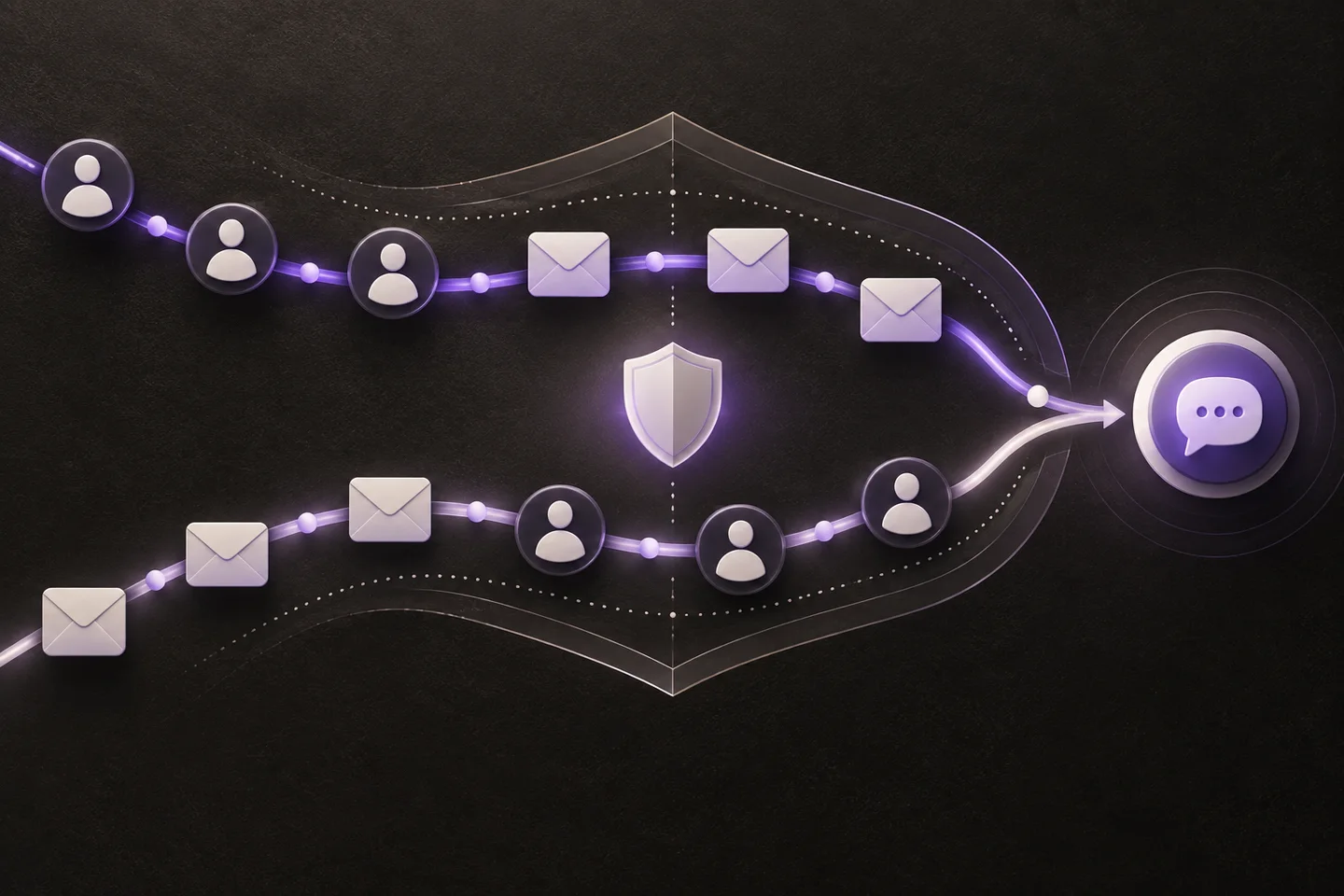
Cold email starts one-to-one conversations with specific people at target accounts. LinkedIn ads create awareness across job titles. The two channels serve different roles in enterprise pipeline building. Cold email drives direct contact. Ads support visibility before buyers reach the active stage. In practice, teams often coordinate both against the same account list.
This Seqnced field guide turns that principle into an operating decision. It explains what to define before execution, how Seqnced applies the approach across a real account universe, what to inspect while the campaign is live, and where teams most often lose commercial signal.
01
What do LinkedIn ads and cold email cost to run?
Seqnced publishes this comparison to help founders and sales leaders budget realistically. LinkedIn advertising has a minimum daily budget of $10 for any format. The minimum lifetime budget for new, inactive campaigns is $100. LinkedIn suggests $25 per day for new advertisers and $50 to $100 per day for existing advertisers. Your campaign enters an auction against other advertisers with similar formats and audiences. Actual costs depend on the target audience, bidding strategy, objective, and relevance score.
According to Metadata.io's 2026 B2B Paid Media Benchmark Report, which covered 153 advertisers and $57.6 million in 2025 paid spend, LinkedIn leads averaged $202. Native Lead Gen Forms cost $193 per lead, while document ads were $142, image ads $200, and video ads $265. Cold email requires dedicated sending infrastructure, deliverability monitoring, and ongoing list maintenance. It does not carry a per-impression auction cost or a platform minimum spend.
LinkedIn charges by Cost-Per-Click, Cost-Per-1,000 impressions, Cost-Per-Video View, or Cost-Per-Send depending on the objective and format. Cold email costs center on infrastructure, data, and labor. A decision rule is to treat cold email as a fixed-cost line item and LinkedIn as an auction variable when building your quarterly budget.
02
Which channel reaches the full buying committee?
Enterprise deals rarely hinge on one person. According to Forrester's "The State Of Business Buying, 2026" press release, the typical buying decision now includes 13 internal stakeholders and nine external influencers. A single LinkedIn Lead Gen Form captures one individual who clicked your ad. LinkedIn requires a minimum audience size of 300 member accounts to run an ad set. This means one form submission represents one voice in a much larger group.
Cold email allows you to start separate conversations with multiple named contacts at the same account. You can sequence the economic buyer, technical evaluator, and end user in parallel. This matters when no single signature approves a $25,000 or larger contract.
LinkedIn ads cover job titles across an account quickly. You can target by job title, job seniority, company size, company name, industry, and skills without needing each person's direct email address. A practical setup check is to verify you have direct emails for each committee member before building a multi-role outbound sequence.
Field guide
The decisions that connect the system
03
Which channel generates more meetings?
The two channels measure success differently. According to Instantly's Cold Email Benchmark Report 2026, the overall average reply rate is 3.43%, the top quartile hits 5.5%, and the top 10% exceed 10%. Fifty-eight percent of replies come from the first email, and 42% come from follow-ups. These replies are direct responses from a named person. You know exactly who responded and can reply directly.
LinkedIn ads produce form fills, not direct replies. According to Metadata.io's same 2026 report, LinkedIn turned $1 of lead-gen spend into $10.20 of pipeline for the 90 advertisers in the sample with connected CRMs, compared with $7.97 across all channels. Lead Gen Forms automatically populate contact and profile information when a member clicks the call-to-action button. Lead quality still has to be checked separately against your ideal customer profile.
Cold email produces direct replies from named individuals. LinkedIn ads produce form fills that your team must qualify and advance. One channel delivers direct responses. The other delivers populated forms. Neither format guarantees a meeting. Both require follow-up.
04
How does each channel fit the enterprise sales cycle?
Timing matters in complex sales. According to 6sense's "The B2B Buyer Experience Report for 2025", buyers initiated 79% of engagements in 2025. The point of first contact shifted from about 69% of the journey in 2024 to 61% in 2025. Buyers are doing more research before they talk to a vendor. Vendors who wait for inbound contact may miss the shortlist entirely.
According to the same 6sense report, 95% of the time the winning vendor is already on the Day One shortlist, and four out of five deals are still won by the pre-contact favorite. If you are not on that shortlist before the buyer reaches out, your odds of winning drop sharply.
According to the LinkedIn B2B Institute's "95-5 Rule", 95% of your potential buyers are not ready to buy today. LinkedIn ads can serve as a long-term memory builder that keeps your firm on the shortlist when the 5% enter an active evaluation. Cold email can start a direct conversation now with a named account and move toward a meeting within weeks. A decision rule is to use ads for accounts not yet in an active buying cycle, and cold email for named accounts you want to contact directly within weeks.
05
Why is LinkedIn cost per lead so high?
LinkedIn's auction competes for a professional audience. According to Metadata.io's 2026 report, LinkedIn leads averaged $202, against $524 on Google Ads, $145 on Facebook, and $138 on Instagram. LinkedIn charges by Cost-Per-Click, Cost-Per-1,000 impressions, Cost-Per-Video View, or Cost-Per-Send depending on the objective and format. Advertisers bid against each other for the same job titles and companies.
Cold email does not use this auction. Once you have verified contact data and dedicated infrastructure, your cost per contact is flat. You do not pay more because a competitor also wants the same audience. Your monthly cost depends on list size and labor, not on how many other advertisers target the same job title. In Seqnced's experience, the relevant comparison is not platform cost alone but whether the contact matches your target account profile.
06
Can you use the same account list for LinkedIn ads and cold email?
Yes. LinkedIn's Matched Audiences feature lets you upload lists for targeting. The minimum audience size required to run an ad set is 300 member accounts. You can run ads to the same companies your outbound team is emailing. Ads show your brand to stakeholders in their feed. A cold email that arrives afterward reaches a recipient who may have already seen the firm name. Leads from LinkedIn can be downloaded as a CSV or synced to a CRM or marketing automation tool. Your outbound team can then enrich those contacts and add them to cold email or LinkedIn sequences. The same account research feeds both channels. One concrete step is to upload your account list to Matched Audiences, confirm the audience meets the 300-account minimum, and let the ads run for a period before cold email starts, so stakeholders have had a chance to see the firm name first. Treat this as a sequencing choice to test, not a proven lift.
- Step: Upload your account list to LinkedIn Matched Audiences and wait for audience matching to complete.
- Step: Start ads before cold email to the same accounts, and compare reply quality against accounts that saw no ads.
- Step: Enrich LinkedIn leads with direct emails before adding them to a cold email sequence.
07
Should you choose one channel or run both?
LinkedIn ads create awareness across job titles in markets where you do not yet have direct contact data. Cold email gives direct access to named individuals. The two channels can be used separately or together against the same account list. Using both together lets the same account see your brand in multiple places.
If your budget forces a choice, start with cold email when you have a defined account list and need meetings this quarter. Start with LinkedIn ads when you need to build awareness across a new market before demand materializes. Either channel can feed the other with data and contacts over time.
A practical test is to run both channels against the same account list for one quarter, then compare the cost per qualified conversation rather than the cost per lead alone.
- Budget check: Do you have verified emails for at least one contact per target account?
- Timeline check: Do you need meetings this quarter or awareness over the next year?
- Measurement check: Are you tracking cost per qualified conversation or only cost per lead?
Application framework
Turn the idea into an operating plan.
A useful guide should change what the team does next. Convert each principle into a decision, an owner, and evidence that can be reviewed after the campaign reaches the market.
According to Metadata.io's 2026 B2B Paid Media Benchmark Report, which covered 153 advertisers and $57.6 million in 2025 paid spend, LinkedIn leads averaged $202. Native Lead Gen Forms cost $193 per lead, while document ads were $142, image ads $200, and video ads $265. Cold email requires dedicated sending infrastructure, deliverability monitoring, and ongoing list maintenance. It does not carry a per-impression auction cost or a platform minimum spend.
Cold email allows you to start separate conversations with multiple named contacts at the same account. You can sequence the economic buyer, technical evaluator, and end user in parallel. This matters when no single signature approves a $25,000 or larger contract.
LinkedIn ads produce form fills, not direct replies. According to Metadata.io's same 2026 report, LinkedIn turned $1 of lead-gen spend into $10.20 of pipeline for the 90 advertisers in the sample with connected CRMs, compared with $7.97 across all channels. Lead Gen Forms automatically populate contact and profile information when a member clicks the call-to-action button. Lead quality still has to be checked separately against your ideal customer profile.
According to the same 6sense report, 95% of the time the winning vendor is already on the Day One shortlist, and four out of five deals are still won by the pre-contact favorite. If you are not on that shortlist before the buyer reaches out, your odds of winning drop sharply.
Cold email does not use this auction. Once you have verified contact data and dedicated infrastructure, your cost per contact is flat. You do not pay more because a competitor also wants the same audience. Your monthly cost depends on list size and labor, not on how many other advertisers target the same job title. In Seqnced's experience, the relevant comparison is not platform cost alone but whether the contact matches your target account profile.
Step: Upload your account list to LinkedIn Matched Audiences and wait for audience matching to complete.
Budget check: Do you have verified emails for at least one contact per target account?
What to measure
Evidence over activity.
- Reachable accounts that match the commercial criteria
- Positive replies separated from neutral or referral replies
- Booked meetings, attended meetings, and qualified opportunities
- Opportunity value and progression after the first conversation
Failure modes
Starting with activity instead of a market thesis
A campaign needs a defined account universe, buyer problem, reason to act, and commercial next step before volume is useful.
Optimizing replies without checking quality
Positive replies matter only when the right accounts attend, qualify, and progress into credible opportunities.
Leaving sales context behind
The handoff should include the account, contact, original angle, stated interest, and expected next step so discovery can continue the conversation.
Key takeaways
The decisions worth carrying forward.
- 01
What do LinkedIn ads and cold email cost to run?: Seqnced publishes this comparison to help founders and sales leaders budget realistically. LinkedIn advertising has a minimum daily budget of $10 for any format. The minimum lifetime budget for new, inactive campaigns is $100. LinkedIn suggests $25 per day for new advertisers and $50 to $100 per day for existing advertisers. Your campaign enters an auction against other advertisers with similar formats and audiences. Actual costs depend on the target audience, bidding strategy, objective, and relevance score.
- 02
Which channel reaches the full buying committee?: Enterprise deals rarely hinge on one person. According to Forrester's "The State Of Business Buying, 2026" press release, the typical buying decision now includes 13 internal stakeholders and nine external influencers. A single LinkedIn Lead Gen Form captures one individual who clicked your ad. LinkedIn requires a minimum audience size of 300 member accounts to run an ad set. This means one form submission represents one voice in a much larger group.
- 03
Which channel generates more meetings?: The two channels measure success differently. According to Instantly's Cold Email Benchmark Report 2026, the overall average reply rate is 3.43%, the top quartile hits 5.5%, and the top 10% exceed 10%. Fifty-eight percent of replies come from the first email, and 42% come from follow-ups. These replies are direct responses from a named person. You know exactly who responded and can reply directly.
- 04
How does each channel fit the enterprise sales cycle?: Timing matters in complex sales. According to 6sense's "The B2B Buyer Experience Report for 2025", buyers initiated 79% of engagements in 2025. The point of first contact shifted from about 69% of the journey in 2024 to 61% in 2025. Buyers are doing more research before they talk to a vendor. Vendors who wait for inbound contact may miss the shortlist entirely.
- 05
Why is LinkedIn cost per lead so high?: LinkedIn's auction competes for a professional audience. According to Metadata.io's 2026 report, LinkedIn leads averaged $202, against $524 on Google Ads, $145 on Facebook, and $138 on Instagram. LinkedIn charges by Cost-Per-Click, Cost-Per-1,000 impressions, Cost-Per-Video View, or Cost-Per-Send depending on the objective and format. Advertisers bid against each other for the same job titles and companies.
Key terms glossary
- Reachable market
- The named accounts and stakeholders that meet the commercial criteria and can realistically be activated.
- Cold-traffic offer
- A clear first-step proposition designed for a buyer who does not already know or trust the company.
- Positive reply
- A response that expresses interest, asks a relevant question, or routes the conversation to the correct stakeholder.
- Qualified opportunity
- A commercial conversation that meets the agreed fit, need, authority, and next-step criteria.
FAQs
Questions teams ask before applying this.
Are LinkedIn ads worth it for enterprise B2B?
LinkedIn ads reach specific job titles at large companies and build awareness among buyers who are not yet active. According to Metadata.io's 2026 report, LinkedIn turned $1 of lead-gen spend into $10.20 of pipeline for advertisers with connected CRMs.
What is the minimum budget for LinkedIn ads?
The minimum daily budget amount required to start on LinkedIn is $10 for any ad format. The minimum lifetime budget for new, inactive campaigns is $100. LinkedIn suggests $25 per day for new advertisers and $50 to $100 for existing advertisers.
LinkedIn ads vs cold email: which gets more meetings?
Cold email produces direct replies through one-to-one outreach. According to Instantly's 2026 benchmark report, the overall average reply rate is 3.43%, with the top 10% of campaigns exceeding 10%. LinkedIn ads generate form fills that your team must qualify and convert into meetings.
Do LinkedIn Lead Gen Forms produce low-quality leads?
Lead Gen Forms automatically populate contact and profile information when a member clicks the call-to-action button. Lead quality still has to be checked separately against your ideal customer profile. The lower cost per lead for forms, $193 according to Metadata.io's 2026 report, does not automatically mean lower quality.
Can you use the same account list for LinkedIn ads and cold email (ABM)?
Yes. LinkedIn's Matched Audiences allows list uploads, and the minimum audience size required to run an ad set is 300 member accounts. You can run ads to the same accounts your outbound team is emailing.
Sources
Where the numbers come from.
Statistics and facts in this guide are taken from the publications below. Figures reflect each source at the time of review and may since have been updated.
- Metadata.io, 2026 B2B Paid Media Benchmark Report↗
- Forrester, The State Of Business Buying, 2026 press release↗
- 6sense, The B2B Buyer Experience Report for 2025↗
- Instantly, Cold Email Benchmark Report 2026↗
- LinkedIn B2B Institute, 95-5 Rule↗
- LinkedIn Help, Maximize your budget↗
- LinkedIn Help, Ad auction↗
- LinkedIn Help, Charging models↗
- LinkedIn Help, Targeting and audience size↗
- LinkedIn Help, Lead Gen Forms↗
- Seqnced, Cold Email Systems↗
- Seqnced, B2B Outbound Systems↗
- Seqnced, Aerospace and Defense↗
- Seqnced, Manufacturing and Distribution↗
- Seqnced, Logistics↗
Related Seqnced resources
See the capability, market, and proof behind the idea.
Put it into practice
Want this thinking applied to your market?
We build and run the outbound system, from the market thesis and account research through campaign execution and reply routing.
Explore managed B2B outbound systems →